
Cardboard Balers for Sale in Australia
Vertical and Channel Cardboard Balers
Supplied, installed and serviced across Australia
A cardboard baler compresses loose boxes into tight, tied bales, so they take up a fraction of the space, cost less to collect and can be sold to recyclers.
Material Recovery Solutions supplies, installs and services Godswill cardboard balers across Australia, from compact vertical balers for a single store to automatic channel balers for distribution centres and recycling facilities.
Tell us how much cardboard you produce each week and we’ll recommend the right model and send you a quote.
Which cardboard baler do you need?
The right baler comes down to how much cardboard you produce each week and how much floor space you have.
| Vertical baler | Channel baler (Godswill F Series) | |
|---|---|---|
| Best for | Retail stores, supermarkets, small warehouses, hospitality | Distribution centres, manufacturers, printers, material recovery facilities |
| Cardboard volume | Low to medium | High, continuous |
| Loading | Manual, door loaded | Hopper, conveyor or bin lifter fed |
| Bale tying | Manual | Automatic |
| Footprint | Compact, fits a back of house area | Larger, needs a dedicated area |
Not sure where you fit? Tell us roughly how many boxes or bins of cardboard you fill each week and we’ll recommend a model.
Vertical cardboard balers
Godswill vertical balers suit businesses that produce steady cardboard waste but don’t have the room or volume for an automatic line. Staff load cardboard through the front door, the ram compresses it, and once the chamber is full the bale is tied and ejected. They’re a common replacement for overflowing cardboard skips behind retail and hospitality sites.
Read more about vertical balers and bale presses.
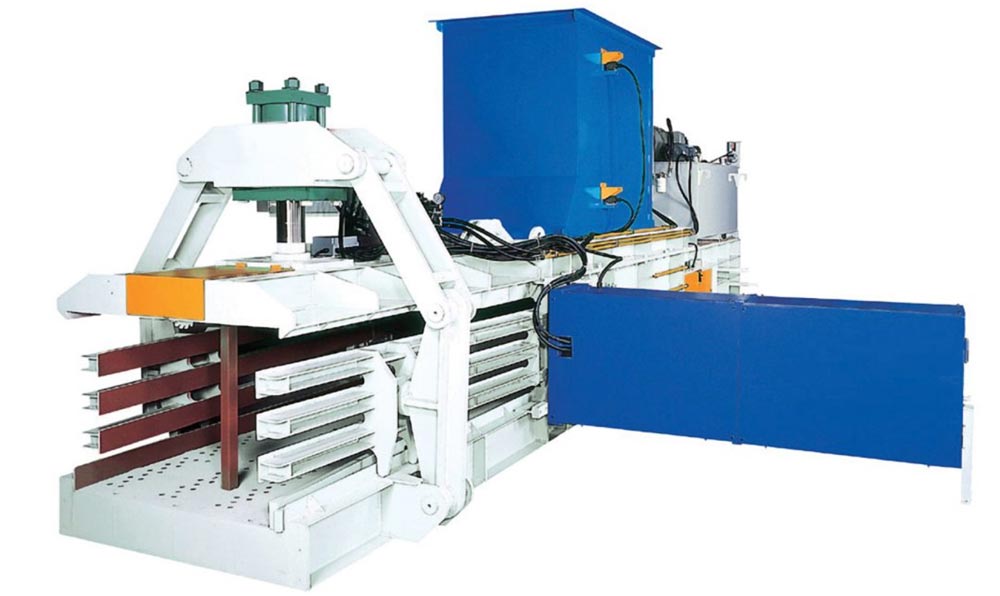
Godswill F Series channel balers
Channel balers are automatic horizontal balers built for high volumes. Cardboard is fed continuously into the hopper, compressed through a channel and tied automatically, so the baler keeps running without an operator stopping to tie bales. The F Series handles cardboard, paper, LDPE plastic film, and steel and aluminium cans.
The F series chassis comes in 4 sizes.
2 smaller sizes are typically used in the Printing waste / Document & Product destruction industries.
GB0505F:
Infeed hopper opening = 0.5m by 0.8m.
Bale size = .5m by .5m by Variable length.
GB7575F:
Infeed hopper opening = 0.7m by 1.2m.
Bale size = .75m by .75m by variable length.
2 larger sizes are typically used in the bulk baling of cardboard & paper / Material Recovery Facilities.
GB1108F:
Infeed hopper opening = 1m by 1.8m.
Bale size = 1.1m by .8m by variable length.
GB1111F:
Infeed hopper opening = 1m by 2.4m.
Bale size = 1.1m by .1.1m by variable length.
All configurations except the 180hp and 240hp include a regenerative circuit for efficient energy use. The right configuration depends on your material type, feed rate and required throughput, our team can help match this to your site.
Explore our advanced GB Series Automatic Cardboard Baling Press for optimal waste management.

How much does a cardboard baler cost in Australia?
Price depends mainly on the baler type, model size, hydraulic power and how it will be fed. Vertical balers sit at the lower end, and automatic channel balers with conveyor feed sit at the higher end. Installation, freight and any conveyor or bin lifter are included in your quote.
Send us your weekly cardboard volume and site layout and we’ll put together a quote for your site.
Is a cardboard baler worth it?
For most businesses filling more than a few cardboard bins a week, yes. A baler pays its way in four ways:
- Fewer collections. Baled cardboard takes up far less room than loose boxes, so bins and skips are emptied less often.
- Income from bales. Clean, tied bales can be sold to cardboard recyclers. Loose cardboard usually costs money to remove.
- Less space and mess. Bales stack neatly on a pallet instead of piling up in loading docks and walkways.
- Easier recycling reporting. Bales can be counted and weighed, which helps with recycling targets and sustainability reporting.
Supplied, installed and serviced by MRS
Material Recovery Solutions is based in Luscombe, South East Queensland, and works with businesses across Australia. Our in house engineers handle supply, installation and ongoing servicing. We attend 90% of breakdowns the same day, with a 95% first time fix rate.
If a channel baler isn’t the right fit, we also supply twin ram balers for very high volumes, closed door balers, and custom built balers for unusual materials or sites. See the full Godswill baler range.

Cardboard baler FAQs
What is a cardboard baler?
A cardboard baler is a machine that compresses loose cardboard into dense, tied bales that are easier to store, transport and recycle.
What is the difference between a vertical baler and a channel baler?
A vertical baler is loaded by hand and suits low to medium cardboard volumes in a small footprint. A channel baler is fed continuously and ties bales automatically, which suits high volume sites like distribution centres and recycling facilities.
What size cardboard baler does my business need?
It depends on your weekly cardboard volume and floor space. Most single retail or hospitality sites suit a vertical baler, while warehouses and recyclers producing cardboard all day suit a channel baler.
How much does a cardboard baler cost in Australia?
Price depends on the baler type, model size, hydraulic power and how it will be fed. Vertical balers sit at the lower end and automatic channel balers at the higher end. Send us your weekly cardboard volume and site layout for a tailored quote.
Is a cardboard baler worth it?
Usually, if you fill more than a few cardboard bins a week. Balers reduce collection costs, free up space and turn cardboard into bales that recyclers will buy.
Can I sell baled cardboard?
Yes. Clean, dry, tied bales can be sold to cardboard and paper recyclers. The price changes with the recycled fibre market, so check with local recyclers for current rates.
What is the difference between a cardboard baler and a compactor?
A baler produces tied bales that can be recycled or sold. A compactor squashes waste into a bin or container but doesn’t produce recyclable bales.
What else can a channel baler process?
Godswill F Series channel balers also handle paper, LDPE plastic film, and steel and aluminium cans.
Do you install and service cardboard balers?
Yes. Material Recovery Solutions installs and services balers across Australia. We attend 90% of breakdowns the same day, with a 95% first time fix rate.
Found this useful? Add us as a preferred source on Google.
Contact Us
Our knowledgeable staff is here to help you find the right solution for your business's specific needs. Call us now or use this form to contact us.
26 Blue Rock Drive
Luscombe, QLD 4207