Chain Conveyors
Material Recovery Solutions Chain Conveyors
MRS chain conveyors are heavy-duty material handling systems built for recycling facilities, manufacturing plants, warehouses and industrial operations. They move bulk materials, scrap, products and waste reliably through your process with minimal downtime.
Material Recovery Solutions supplies and installs custom chain conveyor systems across Australia, sized and configured to suit your throughput, material type and site layout. Our engineers handle installation and provide ongoing servicing and breakdown support nationwide.
What is a chain conveyor?
It moves materials along a fixed path using steel chains instead of a belt. Think of it as the tougher sibling to a belt conveyor, built for heavy or awkward loads that would chew through a lighter system.
How does it work?
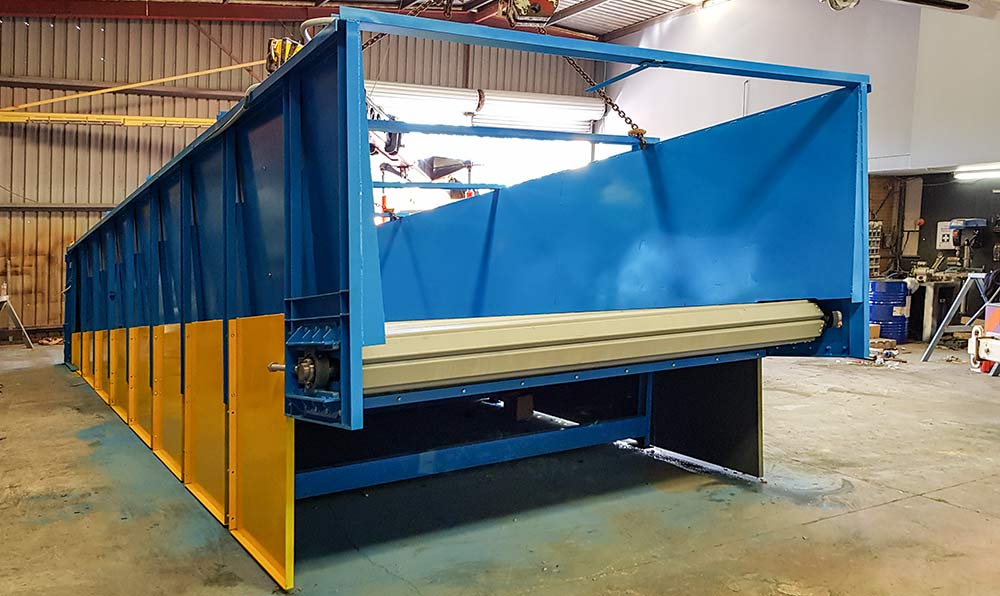
A motor drives a loop of chain, usually running through steel guide tracks or sprockets, and material sits on or is carried between the chain runs as they move. Because the chain itself is doing the carrying rather than a flexible belt, it can push heavier, bulkier or rougher-edged material without wearing through as fast. Depending on your site, it can run flat, on an incline, or feed straight into another machine like a baler or shredder.
Exact speed, load capacity and configuration depends on what you’re moving and your site layout, that’s something our team works through with you rather than a one size fits all spec.
Types of chain conveyors
They aren’t one single design, the right type depends on what you’re moving and how:
- Drag chain: material is dragged or pushed along a trough by the chain, suited to bulk or loose material
- Slat chain: chains carry solid slats or plates that the material rests on, good for heavier or irregular loads
- Apron: overlapping steel pans or aprons attached to the chain, built for the heaviest, most abrasive material
- Inclined: designed to move material up or down a gradient between processing stages
Not sure which setup fits your process? That’s exactly what our team is here for, get in touch and we’ll talk through your material and site.

Why choose one?
- Durability: handles heavy loads and rough environments without wearing out fast
- Versatility: works across mining, food processing, manufacturing and more
- Customisation: built around what you’re actually moving, whether that’s pallets, bins or raw material
- Efficiency: less manual handling means fewer bottlenecks
- Safety: cuts down the manual lifting that leads to workplace injuries, worth a read if you want the wider picture on manual handling risk in Australian workplaces
Things to weigh up
They’re not the right fit for every job, worth knowing the tradeoffs before you commit:
- Upfront cost: generally a bigger investment than an equivalent belt conveyor, the tradeoff is durability under heavy loads
- Maintenance: chains need regular tension checks and lubrication to stay in good condition, this is something we cover as part of ongoing servicing
- Noise: these systems tend to run louder than a belt conveyor, worth factoring in if noise is a concern on site
- Overkill for light material: if you’re only moving light, consistent product, a belt conveyor is usually the simpler and cheaper option
If you’re weighing this up for your site, talk to our team and we’ll help you figure out whether chain, belt, or a combination makes sense for what you’re moving.
Applications
Where chain conveyors get used
Chain systems show up in more industries than you’d expect, from delicate food handling right through to hauling coal. Chain conveyors earn their keep wherever materials are heavy, awkward or need to move without stopping.
1. Food processing
Cleanliness and accuracy matter most here. Chain systems move raw ingredients and packaged product without contamination risk.
2. Sorting and handling
Recycling centres, post depots and warehouses lean on chain conveyors to keep materials moving without bottlenecks.
3. Timber yards
Logs and cut timber are heavy and awkward to shift by hand. Chain conveyors take that weight off your team.
4. Textile manufacturing
Fabrics and yarns move through production lines smoothly, keeping output steady.
5. Automotive assembly
Timing matters on an assembly line. Chain systems keep parts arriving exactly where and when they’re needed.
6. Plant and machinery assembly
Same principle applies in electronics and machinery production, chain conveyors keep the line moving without gaps.
7. Distribution centres
Fast, accurate material flow is the whole job here, and it’s what chain systems are built for.
8. Chemical plants
Raw materials, intermediates and finished product all move safely, even when they’re corrosive or hazardous.
9. Coal mining
Chain conveyors haul coal from the pit through to processing and storage, this is heavy duty work and they’re built for it.
Not sure which setup suits your site? Get in touch and we’ll talk it through.
Other Information
Chain conveyors vs belt conveyors: which one fits?
Comes down to load, material and how gentle the handling needs to be. Chain systems are the go-to for heavy, bulky or abrasive material and rougher environments. Belt conveyors win out when you need gentler, more consistent handling of lighter loads. If you’re still weighing it up, tell us about your site and materials and we’ll point you the right way.
Custom builds
Every site is different, so we build to match. Whether you need a heavy-duty chain conveyor or a belt system for gentler handling, our team can design and deliver it. Get in touch to talk through what you need.

FAQ
What is a chain conveyor system used for?
Moving heavy, bulk or awkwardly shaped materials through a facility. Common uses include recycling and resource recovery, manufacturing lines, warehousing and mining.
How do chain conveyors work?
A motor drives a loop of chain that carries material along a fixed path, either flat, on an incline, or feeding straight into another machine. The chain itself does the carrying, which is why these systems handle heavier and rougher material better than a belt system.
What are the different types of chain conveyors?
The main types are drag chain, slat chain, apron and inclined chain conveyors, each suited to different materials and site layouts. We can help you work out which fits your process.
What is the difference between a chain conveyor and a belt conveyor?
Chain conveyors handle heavier, tougher loads in rougher environments. Belt conveyors suit lighter, more consistent material flow. A lot of sites run both.
What are the downsides of a chain conveyor?
Chain systems generally cost more upfront than a belt conveyor, need regular maintenance to keep the chain tensioned and lubricated, and run louder. For light, consistent material a belt conveyor is often the simpler choice.
Can chain conveyors be custom built for my site?
Yes. We design around your throughput, material type and site layout.
Who are the chain conveyor manufacturers you work with?
We build and supply chain conveyor systems in house, and support you from installation through to ongoing servicing.
Do you service and maintain chain conveyor systems in Australia?
Yes, installation, training and ongoing service and breakdown support across Australia and New Zealand.
Partnering with Material Recovery Solutions
We supply and install chain conveyor systems for businesses across Australia and New Zealand, designed around your site, your materials and your throughput. Ongoing servicing and breakdown support come standard, so your operation keeps moving.
Need a chain conveyor for recycling, manufacturing, bulk handling or anything else industrial? Get in touch and we’ll sort out the right setup for you.
Our service commitment
Minimal maintenance is the goal, but when something does go wrong, we back it up. For breakdowns, we aim to be on-site the same day in 90% of cases, and we fix 95% of issues on the first visit. With a nationwide network of engineers, you’ve got support wherever you’re operating.
Better for the environment too
A chain conveyor isn’t just about moving material efficiently, it’s a lower-impact way to do it. They use less energy than manual or vehicle-based handling, last long enough to keep parts out of landfill, and cut down on the trucks and vehicles that would otherwise be doing the moving. For recycling operations especially, that’s a meaningful part of the sustainability picture, and it’s worth reading how conveyors support zero-waste goals in Australia more broadly.
Works with your shredders and balers
A conveyor rarely runs on its own. Feed it into a shredder or baler at the right pace and the whole line moves better, less jamming, more consistent output, fewer stoppages. Read more about integrating conveyors with shredders and balers.
Contact Us
Our knowledgeable staff is here to help you find the right solution for your business's specific needs. Call us now or use this form to contact us.
26 Blue Rock Drive
Luscombe, QLD 4207